Thursday, June 28, 2012

Sesquicentennial Stories: The Promise of UK #139


Close to 150 years ago on July 2, 1862, an act of Congress, known as the Morrill Act, gave to each state in the Union 30,000 acres of public lands for each Senator and Representative in Congress "for the endowment, support and maintenance of at least one college where the leading object shall be, without excluding other scientific and classical studies and including military tactics, to teach such branches of learning as are related to agriculture and the mechanic arts in such manner as the legislatures of the states may respectively prescribe in order to promote the liberal and practical education of the industrial classes in the several pursuits and professions of life." The act made instruction in those branches of learning related to agriculture and the mechanic arts obligatory. It also made instruction in military tactics obligatory. It made the inclusion of other scientific and classical studies permissive, optional, with the states. The states may, out of this Morrill fund, establish and maintain an Agricultural and Mechanical College only, or they may make the Agricultural and Mechanical College the nucleus of a University organization which shall include agriculture and mechanics as one of its colleges. The University of Kentucky is the outgrowth of the Agricultural and Mechanical College which was established under the provisions of the Morrill Land Grant Act.  Under this allotment Kentucky received 330,000 acres.

Original college building at Woodland Park, A&M.  Classroom building at Woodlands.
 When the Morrill Act passed Congress, the country was in the midst of the Civil War. Educational matters occupied their attention but little. Nonetheless, A&M College became a publicly chartered department of Kentucky University (now Transylvania University) under a cooperative plan authorized by the legislature in 1865. The purpose of this plan was to unite sectarian and public education under one organization. This experiment was tried for a number of years. In the meantime, the federal funds authorized under the Morrill Act were used to develop agriculture and mechanic arts in Kentucky University.

Early view of the UK campus
In 1878, when the people of Kentucky decided to establish a state institution of higher learning, the College of Agriculture and Mechanic Arts was separated from Kentucky University and reestablished on land given by the City of Lexington and Fayette County. Thirty years later the legislature changed the name of the institution to the State University of Kentucky, and gave it additional financial support. In 1916 the name was again changed, this time to the present title, and additional maintenance was arranged by legislative act. 

The Experimental Farm at Kentucky State University, 1899
In the early days of Agricultural Colleges not much agriculture was actually taught because little was known beyond farm experience.   The realization of the scarcity of scientific data gave great impetus to investigations and to the study of sciences related to plant and animal growth.  Recognizing the need for investigation, Congress through the Hatch Act, approved in 1887, appropriated to states $15,000 each for the purpose of establishing experiment stations.  However, the Kentucky Experiment Station was established in December 1885 with Dr. Scovell as director, who continued in that capacity until 1912.

“America’s system of public universities is the legacy of the Morrill Act of 1862 which established new public institutions in each state through the grant of federal lands. The original mission of these new institutions was to teach agriculture, military tactics, and the mechanic arts as well as classical studies so that members of the working classes could obtain a liberal, practical education. The Morrill Act provided a broad segment of the population with a practical education that had direct relevance to their daily lives,” from the Association of Public and Land-grant Universities http://www.aplu.org

To read the original Morrill Act please visit http://www.ourdocuments.gov/doc.php?flash=true&doc=33&page=transcript

Friday, June 22, 2012

Sesquicentennial Stories: The Promise of UK #140

Charley's Aunt, 1915 Kentuckian

The Kernel April 3, 1925
The Strollers, officially organized in 1911, was a group of students who were interested in “dramatics.”  The group was founded by Paul L. Cocke and Ernest Becker, who were the first president and stage manager respectively.  Some of the early performances included Brown of Harvard, The Virginian, The Lost Paradise, The College Widow, Charley’s Aunt, Father and the Boys, The Lion and The Mouse, and Mice and Men.  In the 1920s, early in the first semester auditions would be held for student membership and appearance on Amateur Night, which was held on Halloween.  According the 1924-1925 UK Varsity Handbook, “the present policy is to select a number of one-act plays, of clean wholesome works of good writers, and have everyone present one of that number….  It is Stroller custom and tradition for plays to be cast and directed by Stroller members.  They have a club room in the building formerly occupied as the girl’s gym, but is now divided into workshops for mechanics employed by Superintendent of Buildings and Grounds, with rooms for student publications and Strollers occupying one end.” Over the years, the Strollers began performing in Lexington and around the state.

Thursday, June 14, 2012

Sesquicentennial Stories: The Promise of UK #141


What's In A Name?

The University of Kentucky was chartered in February of 1865 by the Kentucky Legislature, as the Agricultural and Mechanical College of Kentucky, a department established, pursuant to the terms of the Morrill Land-Grant Act of 1862, for the purpose of college-level training in Agriculture and Engineering, within Kentucky University, a private, sectarian institution organized at the same time.


Anatomy and physiology classroom, 1898

1878-1908: Agricultural and Mechanical College of Kentucky 
(Separated from Kentucky University and also known as State College)
Panorama view of the State University, 1911


1916-Present: University of Kentucky
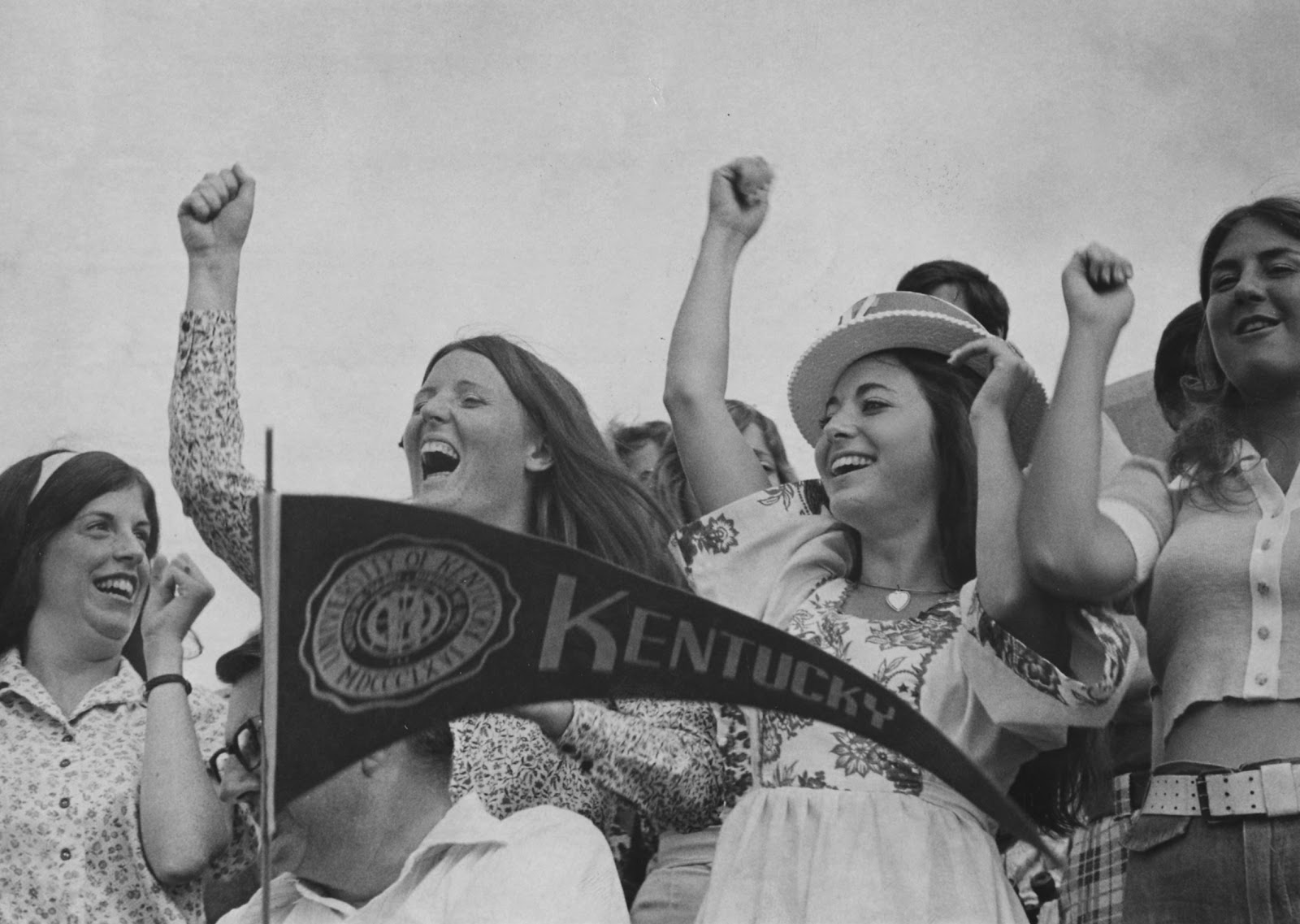
Fans at at UK football game, 1972.

Ensuing denominational and theological controversies, as well as financial difficulties, prompted the Legislature to formally separate the College from the University in 1878, and the former, in 1880, began a century-and-a-quarter of development as an independent institution of higher education on the site of a municipal park and fairgrounds donated by the city of Lexington. In 1908 the A&M College attained University status, and in 1916 it assumed its present name.


1865-1878: Agricultural and Mechanical College of Kentucky
(A college within Kentucky University)

John Augustus Williams, b. 1824-d.1903, First Presiding Officer of the Agricultural and Mechanical College


1908-1916: State University, Lexington, Ky.


Monday, June 4, 2012

Sesquicentennial Stories: The Promise of UK #142

William B. Munson


William Benjamin Munson was born near Astoria in Fulton County, Illinois on January 7, 1845 or 1846. His parents were William and Maria (Linley) Munson.  William Munson was a native of New Hampshire and Maria a native of Maysville in Mason County, Kentucky. William Munson’s early years were spent on a farm but he wanted more education than the county schools offered and he decided to work his way through college. In 1865, William and his brother, Thomas Volney Munson enrolled in the Kentucky Agricultural and Mechanical College.  While students, the brothers boarded together; they did their own cooking and cleaning to save money as they each lived on one dollar per week.  They both did manual labor, earning twenty cents an hour.  In 1869, William Benjamin Munson earned a Bachelor of Science and became A&M’s first graduate (his brother was the second). 

After graduation William Munson worked as a civil engineer with the railroad.  He later practiced law and eventually moved into real estate. Munson organized and was President of the Denison & Washita Valley Railroad Company, and also organized the Southwestern Coal & Improvement Company. 

In 1876, Munson married Ellen Newton in Sherman, Texas and they had six children.  There is a profile of William Benjamin Munson in the October 1915 and 1929 Kentucky Alumnus.

Wednesday, May 30, 2012

Sesquicentennial Stories: The Promise of UK #143


Alfred M. Peter papers

According to the February 18, 1927 issue of the Kentucky Kernel, the bronze cannon in front of the Main building was captured at Santiago, Cuba in the Spanish American War in 1898. It was presented to the Commonwealth of Kentucky by the War Department and later given to the city of Lexington by Governor Bradley in 1903. 
From the 1904 yearbook, Echoes

For many years after placing the cannon in front of the Main Building, men students of the university celebrated athletic victories and other events by firing the cannon.  These ceremonies resulted several times in the breaking of windows in the Main building, so the university decreed that firing the cannon should be abolished.  It was then filled with cement.
Katherine Hobson photograph album circa 1906
The cannon, named Federalista, quickly became the backdrop for campus portraits, hazing activities, and pranks.


Wednesday, May 23, 2012

Sesquicentennial Stories: The Promise of UK #144


James Kennedy Patterson, served from 1869 to 1910 as president of the institutions that were to become the University of Kentucky. Through his vision, diplomatic skills, administrative acumen, and, at times, financial support, the fledgling Agricultural and Mechanical (A&M) College of Kentucky was transformed into an independent state university. 
Ambrotype of a young James Patterson
Patterson was born in the parish of Gorbals in Glasgow, Scotland in 1833. His family emigrated to the United States in 1842, when he was nine years of age, and settled near Madison, Indiana. Patterson received his B.A and Master of Arts degrees from Hanover College (Indiana) in 1856 and 1859, respectively, and an honorary Ph.D. from the same institution in 1875. In 1859 he married Lucelia Wing, daughter of a wealthy New Bedford, Massachusetts whaler who had moved to Kentucky about 1800. The Pattersons had two children, Jeanie Rumsey, who died in infancy, and William Andrew, who passed away in 1895 at the age of 27. 
Lucelia Wing Patterson
With the merger in 1865 of Transylvania College, Kentucky University (in Harrodsburg), and the newly state-chartered Agricultural and Mechanical College of Kentucky, Patterson was appointed professor of Latin and Civil History in this enlarged Kentucky University. At the same time he secured the chair of History and Metaphysics, which he occupied until 1910. In 1869 Patterson was elected third Presiding Officer of the University's now constituent Agricultural and Mechanical College. After denominational and theological bickering and debilitating financial hardship experienced by the hybrid institution, the State Legislature in 1878 formally separated the A&M College from KU, and Patterson assumed the position of president of the independent school.
Faculty of  A&M in 1885, first row, left to right: W. D. Lambuth, Latin and Greek Languages, President James K. Patterson (with the crutch), James G. White, Mathematics, second row, left to right, John Shackleford, English, third row, left to right, Dr. Robert Peter, Chemistry, and son, Alfred M. Peter, Chemistry, fourth row, left to right, J. C. McClelland, Academy and Lieutenant L. E. Phelps, Commandant, fifth row, left to right, A. T. Parker, Microscopist, F. M. Helveti,French and German Languages, (with long white beard and glasses), Walter K. Patterson, Academy, sixth row, left to right, J. R. Potter, Pedgogy Education, (with heavy facial hair except for chin), A. T. Parker, Microscopist, seventh row, left to right, A. E. Menke, Agriculture Chemistry, A. R. Crandall, Natural History, Maurice Kirby, Philosophy, John H. Neville, Greek and Latin, with no hat, and in the window, James K. Patterson's son, William A. Patterson.

One of the A&M president's foremost administrative efforts, following the erection of the college's first buildings on its new Lexington Fairgrounds site, ultimately at his own expense, was an attempt to repair the fiscal damage incurred by the school during its preceding thirteen years of existence in linkage with Kentucky University. To this end he led the fight to convince the Kentucky General Assembly to enact legislation establishing a one-half-cent state property tax to raise desperately needed funds to support the struggling College. The climax of his crusade - an impassioned speech on the floor of the Senate - succeeded in sweeping away the formidable, organized opposition to the tax, and the measure was approved in 1882. The revenues from this new tax, however, proved insufficient to provide for the college's stability and continued growth. With the financial situation of the institution in question, Patterson considered other means of fundraising. When all other options had been exhausted he secured a personal loan to procure the needed money.
President Patterson at his desk
Patterson proved a capable chief executive, administering the daily operations and affairs of the A&M College wisely and economically, although he was criticized by his detractors as unduly tyrannical and miserly, the latter particularly as it related to the salaries of employees and to physical expansion. Many in the community and state likewise felt that the president was incorrectly removing the college from its moorings in agricultural and engineering instruction, as mandated by the Morrill Land Grant Act, and setting it on a course of becoming an essentially liberal arts institution.
Dedication of the Patterson statue in 1934
Increasing curricular diversification led to upgrade A&M's official academic classification, and Patterson and his Board of Trustees in 1908 successfully lobbied the General Assembly in support of changing the school's name to: "State University, Lexington, Kentucky". He continued as president for two more years, assisting in the transition of the institution to University status. In 1910 he retired from the presidency. The Board of Trustees unanimously approved his stipulated conditions which included: attendance at Board and faculty meetings; serving as adviser to the incoming President and as representative of the University on the state and national level; and continued residence in the campus house built for the President in 1882, which he occupied until his death in 1922. The life and legacy of Kentucky's "Pater Universitatis" are today honored in University buildings and a roadway which bear his name, and in the great seated statue of the founder, erected in 1934, which sits adjacent to the institution's Main Building and astride the campus he built and nurtured.


Adapted from James Kennedy Patterson(1833-1922), 1869-1910 by Rob Parmley, Nancy DeMarcus, and Frank Stanger http://libraries.uky.edu/libpage.php?lweb_id=320&llib_id=13

The Guide to the James K. Patterson presidential papers, 1856-1957 can be found on ExploreUK at http://exploreuk.uky.edu/catalog/xt7ghx15n565/guide