Thursday, September 20, 2012

Sesquicentennial Stories: The Promise of UK #127


Women’s basketball was established on the University of Kentucky campus in 1902.  Making the 1902-03 women’s basketball team the first of either sex at the then called State College to play a full intercollegiate schedule.

At State College, there was no place to play basketball until Barker Hall was built. Even then, basketball was not a spectator sport for the simple reason that the gym could not accommodate more than those who could stand around the floor of the balcony, which was also the running track.  From 1903 on, the men shared the gym with the women.


Old gymnasium in Barker Hall, circa 1901
 
Women’s basketball was taken quite seriously by the women themselves, but not, it seems, by the men students. According to Hail Kentucky by Helen Deiss Irvin,  A “Kentuckian” of 1904 reports a game as one vast tide of straight hair, stray hair, curls and ribbons reversed and cries of ‘Here Rebekah,’ and ‘Oh, Gemima, how could you?’”  That same year one Herman Scholtz disguised himself as a girl and went to Georgetown with the coeds, obviously with their connivance.  There he watched a spirited contest forbidden to male spectators.  He had to be punished, but the faculty was at a loss.  Although there were more than 180 specific rules, nobody had ever thought to include one against dressing up as a girl.  Scholtz got a general reprimand. 


Women's basketball team, Kentucky State College, 1903.  Photo shows the Women’s Basketball team of 1902-03, made up of Miriam Nave, Alice Pence, Nell Norwood, Fanny Redd, Amanda Maull, Helen Jaeger, Willie Spier, Jimmie Offutt and Mary E. Clarke.  They were coached by Jane Todd Watson.
For the first few years of its existence on UK's campus, the women's basketball team mostly played inter-class scrimmages, only playing one or two intercollegiate games per season. All games were carefully monitored by Florence Offutt Stout, the women's physical education director and first Dean of Women, and no spectators were allowed.  Stout was a proponent of "medical gymnastics," a more gentle form of physical exercise targeted at promoting physical health and eliminating obesity, and considered competitive sports at odds with this program.

Kentucky women's basketball team, 1921, with student coach Sarah Blanding
 In 1909, the women's basketball team complained via a petition to the faculty senate stating that Stout did not support the development of the sport and asked that the athletic association take over the management of the team. This started a power struggle which stretched over almost two decades among Stout, women students in favor of the sport, and the athletic association.  In 1924, bolstered by the support of Sarah Blanding -- the new Dean of Women -- Stout finally convinced the University Senate and UK President Frank McVey that basketball was "too strenuous for girls." McVey cited this "strenuousity" and the claim that road trips for the team were prohibitively expensive due to "the necessity of proper chaperonage" as reasons for banning women's basketball. This was in spite of the fact that the 1923-1924 women's team had won the Southern Intercollegiate Championship after an undefeated 10-0 season. All women's intercollegiate varsity sports were discontinued on November 13, 1924. Ironically, the 1924-1925 season marked the first season of men's basketball play in Alumni Gym and a rise of popularity in the game on campus.


In the next decades, women's basketball continued to be played in physical education classes, and later as an intramural sport, but organizing campus dances became the primary focus of the Women's Athletic Association. It was not until 1974 that women's basketball was reinstated as a varsity sport, with Sue Feamster serving as the first coach of a varsity team in fifty years.

Gregory Kent Stanley has written a fuller account of the early years of women's basketball and the campus politics affecting it in his book Before Big Blue. UK Athletics offers a historic timeline of women's basketball achievements on its website under "History and records."

Thursday, September 13, 2012

Sesquicentennial Stories: The Promise of UK #128


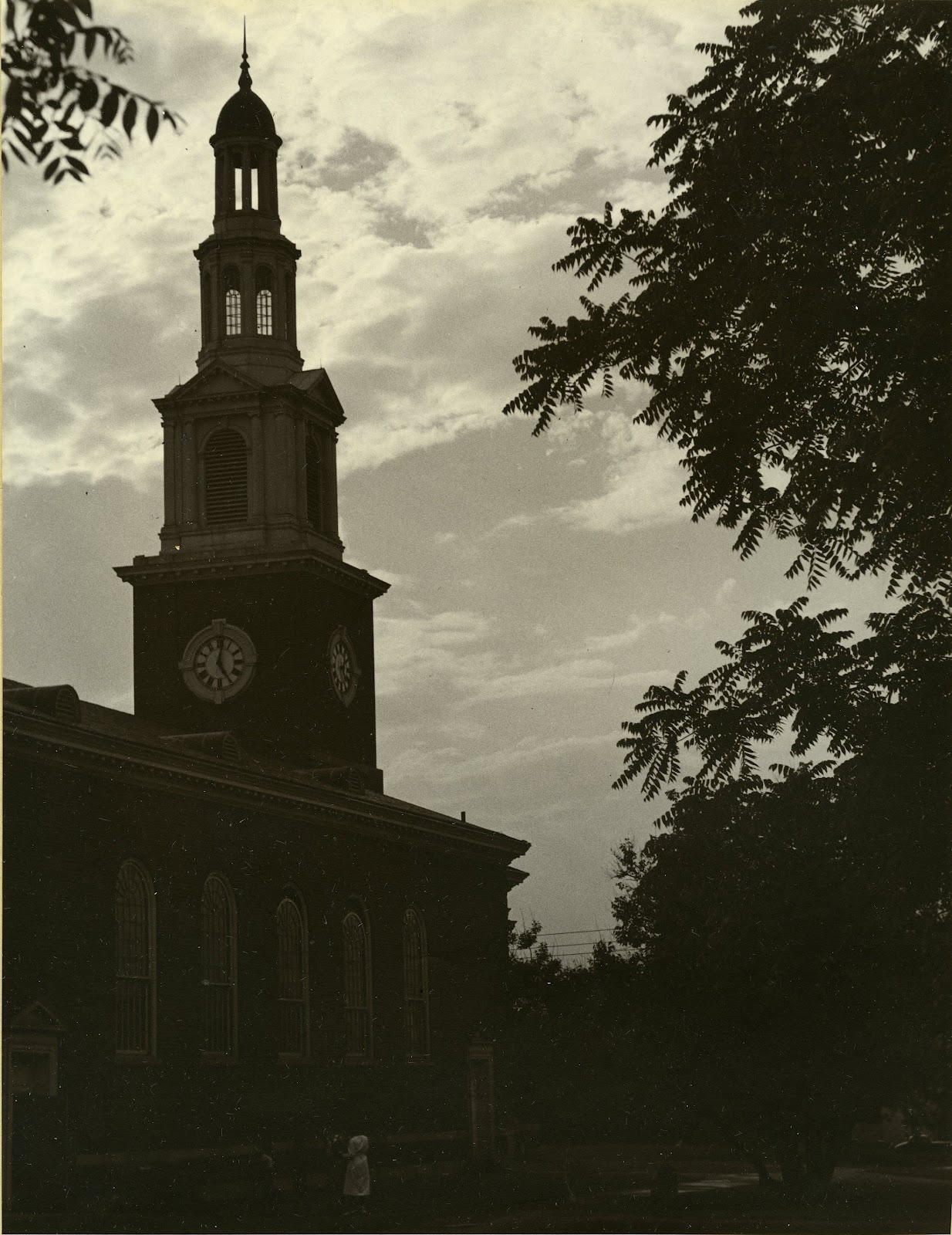
For many years a campaign had been carried on throughout Kentucky for funds with which to erect a building to serve as a memorial to UK students, alumni, and faculty who served in World War I.  Contributions came in sporadically, and at one time consideration was given to using these funds in building a gymnasium and a stadium, a plan which was not executed.   Finally it was decided that an auditorium would be built.  


The auditorium, with a seating capacity of 1100, which came to be known as Memorial Hall, was dedicated on Memorial Day 1929 with Under Secretary of War Patrick J. Hurley as the principal speaker.  


The front view is marked by the tower and a Corinthian-columned porch. It was, at the time, the most dramatic building on campus and it was destined to become the most photographed.  The university supplemented private contributions and built the auditorium in New England church style.  With its stage and pipe organ, Memorial Hall filled the long-standing need for a facility for concerts, lectures, and some activities of the music department.  


The Greek semi-circular amphitheater built behind Memorial Hall, was used for concerts, motion pictures and other programs during the warm months.  It was a standard feature of campus beautification in American colleges of the 1920’s.  It is still used today.

Thursday, September 6, 2012

Sesquicentennial Stories: The Promise of UK #129


Greek letter fraternities were slow to appear on the Agricultural and Mechanical College campus, partly because of opposition by the faculty to their establishment.  In October, 1887, the faculty received a request from students for permission to organize a “Greek Society,” described as a “secret society for promotion of morality, high class standing, etc.,” but on the ground that secret societies were  undesirable, the petition was rejected.  The issue continued to arise at irregular intervals.  Early in 1893 President Patterson himself presented to the faculty a petition from some of the students who wanted permission to establish a fraternity.  On this occasion, the faculty appointed a committee to study the question and at the next regular meeting recommended that the petition be granted.  The report of the committee was then adopted by a margin of 14 to 3. 

Sigma Chi
The first two fraternities:  Kappa Alpha and Sigma Chi established chapters on the campus, but seven years passed before others followed them.  Then in rapid succession five additional groups appeared:  Sigma Alpha Epsilon in 1900; Kappa Sigma, Phi Delta Theta and Pi Kappa Alpha in 1901; and Sigma Nu in 1902. After another 7 years, Alpha Tau Omega established a chapter at the State University.  

Alpha Xi Delta Sorority
The women students were even slower than the men in establishing Geek letter societies.  Several local organizations came into existence shortly after 1900, but not until 1907, when Alpha Xi Delta came to the campus did a women’s group have national affiliations.  A chapter of Alpha Gamma Delta received a charter in 1908 and in the year of Patterson’s retirement, a third national sorority, Kappa Kappa Gamma, established a chapter.

Honorary societies included Lamp and Cross, Mystic 13, and Tau Beta Pi and toward the end of Patterson’s administration a fourth, Key Roll, was established.  

Engineering Fraternity
The Agricultural and Mechanical College chapter of Tau Beta Pi, an honorary engineering fraternity, was established in 1902.  Membership was based on scholarship and only students in the last two years of engineering were eligible to join.  

1973 Kentuckian
There are currently 19 Sororities and 24 Fraternities on UK’s campus. Last year over $427,600 was raised by the Greek community and given to various charities and over 52,000 service hours were performed.  The Greek community joined with the UK chapter of Habitat to build a Habitat house for a UK employee.

Friday, August 31, 2012

Sesquicentennial Stories: The Promise of UK #130


Broom brigades were women’s organizations that spread throughout the United States during the 1880s. Mark Twain observed in his 1883 book Life on the Mississippi that “in the West and South they have a new institution—the Broom Brigade. It is composed of young ladies who dress in a uniform costume, and go through the infantry drill, with broom in place of musket.” He described the broom brigade of New Orleans: “I saw them go through their complex manual with grace, spirit, and admirable precision. I saw them do everything which a human being can possibly do with a broom, except sweep.”


The members of the 1888 Broom Brigade from left to right: unidentified woman; Minnie Moore (later a school teacher);  Mrs. Ernest Cassity (Minnie’s sister); Sally Belle Baker; Mayme Combs; Elmer Allen; Kate Baker; Hattie Warner; Annie Baker, and Sallie Hornbrook. On the steps are: Mary Lou Baker; Vergie Hearne; and Joe Hearne.  The Broom Brigade would drill with brooms as the cadets did with guns. In the post-Civil War era, military drill was a popular form of exercise, and judged drill competitions between rival college battalions was entertainment. It is speculated that in many broom brigades across the country, that it wasn’t the chance to play with guns that inspired the coeds as much as to get some exercise – and to be able to do the same thing that men were doing.

In an ad for The Broom Drill, Broom Brigade Tactics, for Exhibitions, Roller Rinks, Social Clubs and Church Entertainments it is described as the most “novel, attractive and  entertaining exhibition of graceful military movements, performed by young ladies….Easy to learn, and a profitable exercise.” 

Both domestic in nature, in their choice of using brooms, but also an expression of equality the broom brigades were an indication of the changing role of women.